










29 October 2026
Latest News
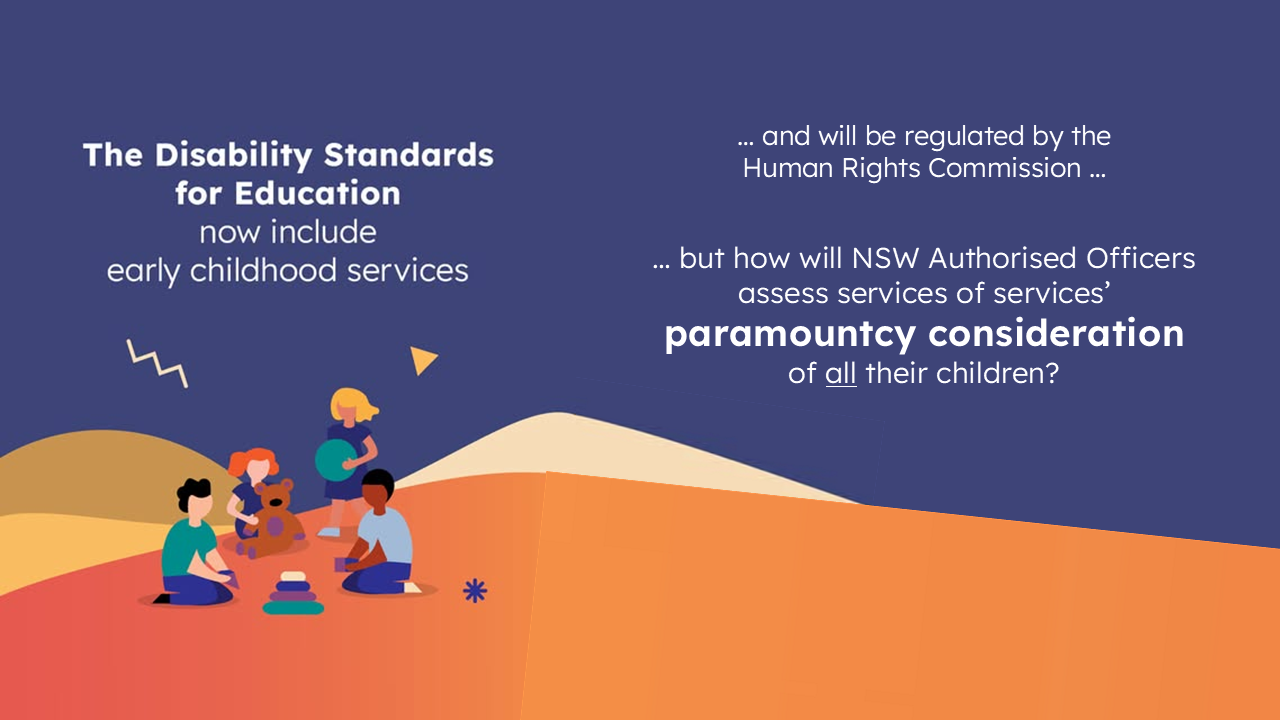
Members would have received communications from the Federal Department of Education and ACECQA about the updated Disability Standards for Education 2025 (in relation to the Disability Discrimination law) are in effect from 1 August 2026.
While technically early childhood education and care services were always obliged to follow the Disability Discrimination Act since 1992, both the Federal Department of Education and ACECQA are highlighting long daycare services' inclusion from beginning 1 August 2026.
It is important to note that the Australian Human Rights Commission (AHRC) is the regulator for this law and how such Disability Standards for Education are expected to be implemented.
Thanks to members' input, ACA National's submission about the then proposed changes to the Disability Standards was submitted in February 2025.
As the National Quality Framework was implemented since January 2012, all early childhood education and care services would already have policies, procedures, practices and more for all children, including with respect to Quality Area 2 - Children's Health and Safety.
That said, members and the sector would also be aware of the challenges facing them due to:
the limitations of the Inclusion Support Program funding; and
the rigidity of the worker retention payments and its capping of fees to parents.
And since 24 April 2026, “the safety, rights and best interests of children must be the paramount consideration in every decision and action across early childhood education and care” became a legal requirement on all Approved Providers and services.
ACA NSW wrote to the NSW Early Learning Commission (NELC) requesting that they publish clear guidance on how paramountcy must be implemented in light of these expectations of supporting children with any and all disabilities.
The NELC responded on 8 September 2026 (in part as follows):
"The Commission does not consider these obligations to be in conflict.
The paramountcy principle does not require services to adopt a zero-risk approach or to exclude children because they may require additional support, adjustments or individualised strategies to enable their safe and meaningful participation. A child's disability, support needs or the fact that a service must consider and implement reasonable adjustments should not, of itself, be treated as creating an unacceptable compliance risk.
Rather, decisions concerning individual children should be made having regard to the circumstances of the child, including their safety, rights, wellbeing, developmental needs and best interests.
We also recognise the broader operating environment identified in your letter, including workforce pressures and the challenges experienced by services in accessing appropriate inclusion supports. While these matters extend beyond the Commission's regulatory responsibilities, we will continue to engage with relevant Commonwealth and NSW agencies and sector stakeholders on issues affecting the capacity of services to meet their obligations."
Notwithstanding the response from NELC, ACA NSW remains concerned that services may turn away children from or reject their enrolments for their offerings of early childhood education and care for fear of not being able to fulfil the paramountcy expectations of the Authorised Officers of the NSW Early Learning Commission. In other words, NSW-based early childhood education and care are likely to take the path of least or zero risk in order to care for the greatest possible number of children by avoiding all risks (including regulatory non-compliances).
For any further information/clarification, members can contact the ACA NSW team via 1300 556 330 or nsw@childcarealliance.org.au.
UPDATED: 8 SEPTEMBER 2026
FIRST PUBLISHED: 11 AUGUST 2026